

Canonical is bringing thoughtful, local-first AI to Ubuntu – enhancing accessibility, enabling intelligent agents, and keeping user privacy and open source values at the core.
As we move through 2026, large language models (LLMs) and AI tools have become ubiquitous across the tech industry. Adoption varies widely – some projects dive in headfirst, while others proceed with caution.
For Ubuntu users and the broader open source community, one big question keeps coming up: What role will AI play in Ubuntu’s future? Which distro will be the first to integrate?
Canonical’s VP of Engineering, Jon Seager, recently shared a detailed vision on the Ubuntu Discourse. The message is clear: Ubuntu won’t become an “AI product,” but it will grow stronger through principled, user-focused AI integration. Here’s a quick rundown with opinion.
Table of Contents
Canonical’s Internal Adoption
Canonical is ramping up AI adoption internally in a focused way. Rather than chasing vanity metrics like “percentage of code written by AI,” the company emphasizes education and experimentation. Engineers are encouraged to try different tools, understand their strengths and limitations, and use them where they truly add value – such as accelerating mechanical tasks, prototyping, troubleshooting, or learning new concepts.
The guiding principles are responsibility and transparency. Canonical wants to avoid “AI slop” – low-quality, unvetted contributions that have plagued some open source projects. AI won’t replace engineers at Canonical; instead, engineers who master these tools effectively will thrive. The focus remains on delivering high-quality results, with human oversight and review.
Implicit vs. Explicit Features
Seager introduces a helpful distinction between implicit and explicit AI features:
- Implicit AI: Enhances existing functionality behind the scenes without changing user mental models. A prime example is dramatically improved speech-to-text and text-to-speech for accessibility. These feel like better core OS features, powered by efficient local open-weight models like Gemma family, GPT OSS etc.
- Explicit AI: New, obviously AI-driven capabilities, such as agentic workflows for document authoring, automated troubleshooting, personal automation (e.g., daily news briefings), or even helping users manage complex Linux tasks.
Implicit features improve what Ubuntu already does well. Explicit ones will roll out as optional, preview-style additions.
Inference Snaps and Open Models
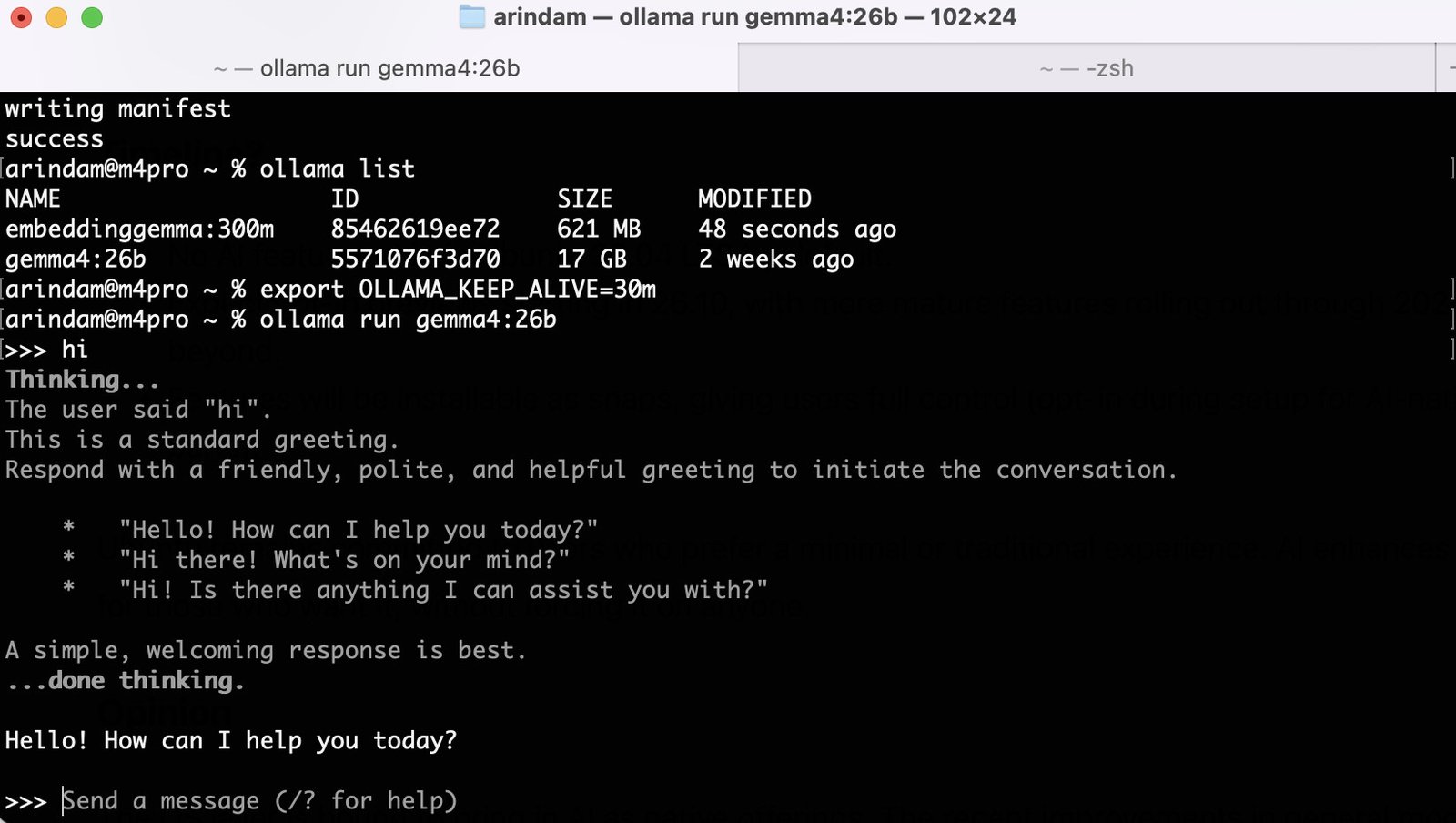
Ubuntu’s strategy heavily favors local inference by default. This aligns with open source values, privacy, and security. Canonical is expanding inference snaps – easy-to-install, hardware-optimized packages for running models locally.
snap install nemotron-3-nano # Example – optimized for your hardwareThese snaps use the same confinement and security model as other Ubuntu snaps, ensuring models don’t have unrestricted access to your data or system. Canonical partners with silicon vendors to deliver optimized performance across a wide range of hardware, from commodity laptops to more powerful machines.
Recent advances in smaller, capable models (like Gemma 4 or Qwen variants with strong tool-calling) make local AI increasingly powerful for tasks like web search, API interaction, file system operations, and reasoning beyond training data.
Toward a Context-Aware, Agentic Ubuntu
The vision extends beyond isolated features to a more intelligent, context-aware operating system. LLMs could help demystify Linux’s power for newcomers – troubleshooting Wi-Fi, setting up secure services, interpreting logs for SREs, or enabling voice/mobile control of your machine – all while respecting existing security boundaries, audit trails, and permissions.
Snaps and Ubuntu’s consolidated core will help deliver these capabilities safely. AI agents would operate within strict guardrails, inheriting the same controls used in production environments today.
Performance, Efficiency, and Hardware Readiness
Local AI depends on hardware, but the gap is closing fast. Silicon manufacturers are building better consumer-grade accelerators, and efficiency (especially power draw) is improving dramatically. Canonical’s silicon partnerships position Ubuntu to take full advantage as capabilities grow.
Smaller models already run well on everyday hardware for many tasks, and the trend points toward broader accessibility.
Timeline?
- No AI features ship in Ubuntu 26.04 LTS by default.
- Expect opt-in previews starting in 26.10, with more mature features rolling out through 2026 and beyond.
- Features will be installable as snaps, giving users full control (opt-in during setup for AI-native parts).
Ubuntu remains committed to users who prefer a minimal or traditional experience. AI enhances the OS for those who want it, without forcing it on anyone.
Opinion
The OS layer is bound to bring in AI as native offerings. The recent improvements in general models with agentic capabilities brings a pivotal point of OS shippers such as Canonical and Red Hat. The open source models are good enough to run locally, such as Gemma 4:26B and others.
This brings to a point where the Ubuntu, being the most used Linux distro in the world, can slowly bring in snap-based AI inference for its end users for better experiences. The settings, checking logs, troubleshooting, and accessibility can be easily improved with careful UI integration and AI.
Who would have thought Snap can be a helpful for AI?
This approach positions Ubuntu to make advanced AI accessible while leading by example in the open source world.
What do you think? Are you excited about local AI features in Ubuntu, or do you prefer keeping things minimal? Share your thoughts in the comments or join the discussion on the Ubuntu Discourse thread.


